
How well does your church actually understand its mission?
MSTRD is running a study on missional decay — how far a church's mission travels from the people who set it to the people in the seats. Add your voice, whatever your role.
Anonymous · about 4 minutes · results published Q1 2026
MSTRD Research
The Mission
Clarity Study
2026 · Wave 1
How far does a church's mission fall from the people who set it to the people in the seats?
Results published Q1 2026
MSTRD Insights
A research effort and a platform, working on the same problem from two sides.
Our mission is churches on mission
Most churches can state a mission. Far fewer can show that the people carrying it out understand it the same way. MSTRD Insights exists to measure that gap in the open and help churches close it.
We focus on four things a healthy church keeps in sync:
Mission
A purpose people can state in their own words — not just find on a wall.
Alignment
Leaders, staff, and volunteers pulling toward the same next step.
Communication
Decisions that actually reach the people who have to carry them out.
Action
Readiness to move when the moment comes, not just plans on paper.
The MSTRD platform
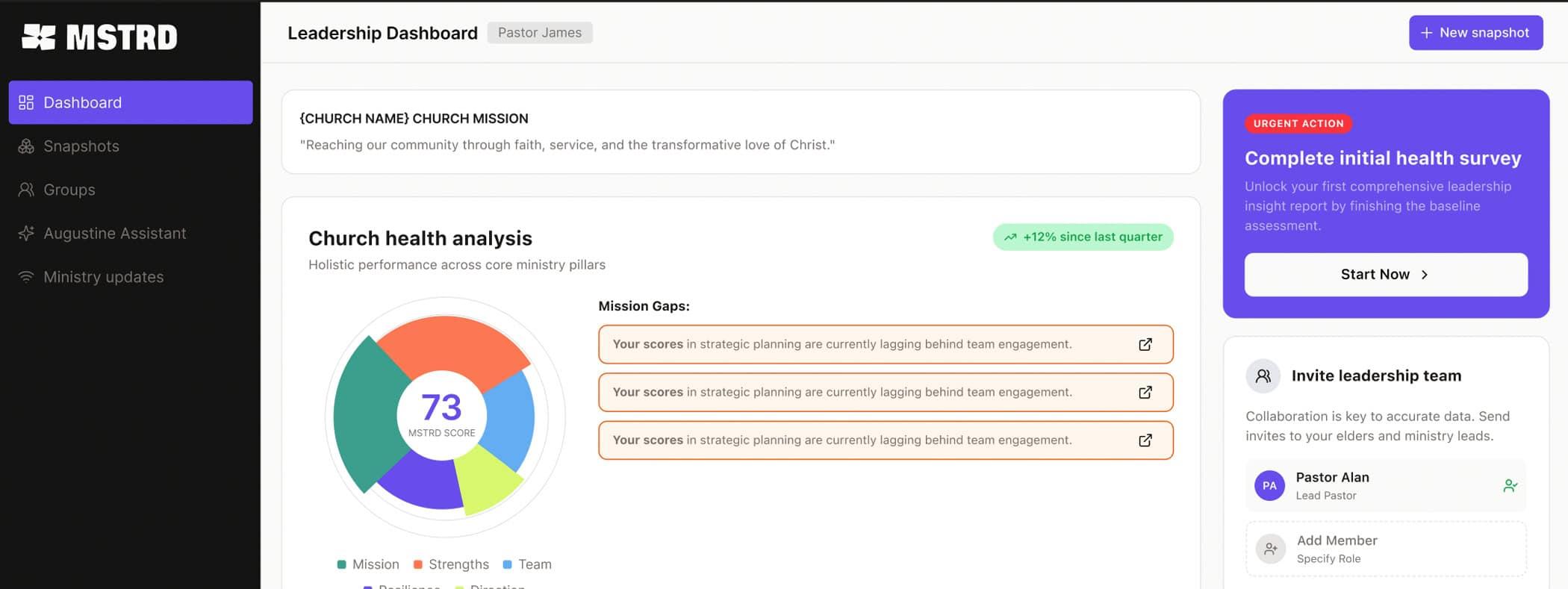
MSTRD is a church health platform. It measures a church across five dimensions — Mission, Strengths, Team, Resilience, and Direction — through short assessments taken by leaders, staff, volunteers, and attenders.
Those responses become a single score, a set of AI-surfaced mission gaps, and a plain-language read on what to do next — the kind of insight that used to require an outside consulting engagement.
Church data, three ways
The charts library is live now, built from published research. Full data stories and reports arrive with MSTRD's first study in Q1 2026.
Charts
LiveInteractive charts drawn from published church research — Pew, Lifeway, Springtide — each one sourced and shareable.
Browse the charts →Stories
Q1 2026Short reads that take a single finding and work out what it means for a church's next step.
See the format →Reports
Q1 2026In-depth releases that pull the whole picture together across mission, team, resilience, and direction.
See the format →The standard behind every number
Four voices, not one
Every church metric is built from senior leaders, paid staff, volunteers, and regular attendees — weighted so no single perspective speaks for the whole.
Quarterly pulse
A short recurring poll tracks the same questions over time, so movement is measured, not recalled.
Benchmarked across churches
Scores are anonymized and aggregated, then compared by size, tradition, and region to give each church a peer set.
Open methodology
Question wording, sample composition, and weighting are published with every release. Findings link back to the raw distributions.
Checked against outside research
A standing scan of academic, denominational, and industry research flags relevant external findings for review — context for MSTRD's own numbers, never a substitute for them. See Sources.
New findings, in your inbox
One email each time MSTRD publishes new church data — the charts and what they mean.
Church leaders and researchers. No spam. Unsubscribe anytime.